
Member of the Judicial-Legal Council and Chairman of the Baku Court of Appeal Participates in the 19th Plenary Meeting of the CEPEJ Network of Pilot Courts
02.04.2026



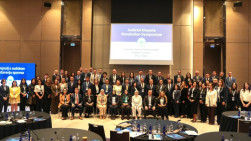
On March 31, the 19th Plenary Meeting of the Network of Pilot Courts of the European Commission for the Efficiency of Justice (CEPEJ) was held in Maastricht, the Kingdom of the Netherlands. The event was attended by Mr. Mubariz Akbarov, Member of the Judicial-Legal Council and Chairman of the Baku Court of Appeal, which is a member of the Council of Europe's Network of Pilot Courts.
During the plenary session, participants discussed the role of the pilot courts in supporting the work of CEPEJ, reviewed the Commission's achievements in 2025, and considered its priorities for 2026. The CEPEJ Crystal Scales of Justice Prize was also presented. In addition, pilot courts were informed about the latest CEPEJ tools and instruments, while participants shared their views and exchanged feedback on the Commission's ongoing activities.
As part of the meeting, Mr. Mubariz Akbarov addressed a thematic seminar, noting that Azerbaijan's modern judicial system continues to evolve in line with contemporary requirements as a result of the judicial and legal reforms implemented in the country. He presented recent amendments to the national legislation introducing qualitative and quantitative performance indicators for assessing judges' professional performance, as well as the quality criteria incorporated into the newly approved Rules and Methodology for the Evaluation of the Performance of Judges adopted by the Judicial-Legal Council. Mr. Akbarov also provided information on the new version of the "Electronic Court" information system, highlighting its key features, advantages, and its forthcoming launch in Azerbaijani courts. Furthermore, he addressed the opportunities and potential risks associated with the use of artificial intelligence and digital technologies in judicial proceedings, particularly with regard to judicial impartiality, transparency, and access to justice.
The meeting also featured discussions and exchanges of experience on a range of issues, including the automation of judicial processes, the environmental impact of court operations, key aspects of modern court management and judicial training methodologies, indicators for measuring the quality of justice, and the application of digital technologies and artificial intelligence within the judiciary.
The event made a significant contribution to strengthening dialogue and cooperation among the pilot courts and facilitated the exchange of best practices aimed at enhancing the efficiency and quality of judicial systems.
Göstərilən platformalarda paylaş:
Digər


Judges Participated in a Study Visit to Türkiye
Azerbaijani Judges Participated in an International Event in Istanbul